# How to break down the energy of a residue ionization?
## How to break down the energy of a residue ionization?
MCCE calculates theoretical pKas as well as explain why these residues have those pKas.
### Continuum Electrostatic interpretation of pKa
#### Free energy and pKa
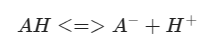
An amino acid and conjugate base in equilibrium:
[](https://mccewiki.levich.net/uploads/images/gallery/2025-06/image.png)
The free energy of the reaction has relationship with the equilibrium of:
[](https://mccewiki.levich.net/uploads/images/gallery/2025-06/m6jimage.png)
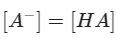
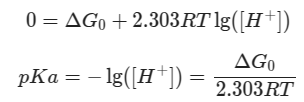
At the equilibrium of midpoint where
[](https://mccewiki.levich.net/uploads/images/gallery/2025-06/vMHimage.png)
therefore residue pKa is linked to the reaction free energy:
[](https://mccewiki.levich.net/uploads/images/gallery/2025-06/oKjimage.png)
#### The acids in solution and in protein
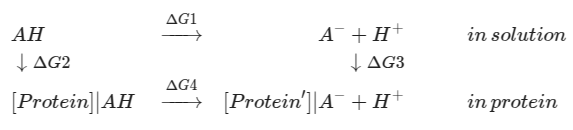
We know the ionization energy in solution, which is represented by the solution pKa:
[](https://mccewiki.levich.net/uploads/images/gallery/2025-06/Hi0image.png)
*ΔG2" id="bkmrk-%CE%94g1" role="presentation" style="box-sizing: inherit; display: inline-block; line-height: 0; text-indent: 0px; text-align: left; text-transform: none; font-weight: normal; font-size: 20.944px; font-size-adjust: none; letter-spacing: normal; overflow-wrap: normal; word-spacing: normal; white-space: nowrap; float: none; direction: ltr; max-width: none; max-height: none; min-width: 0px; min-height: 0px; border: 0px; margin: 0px; padding: 1px 0px; position: relative;" tabindex="0">ΔG1* is solution pKa, and *ΔG4" id="bkmrk-%CE%94g4" role="presentation" style="box-sizing: inherit; display: inline-block; line-height: 0; text-indent: 0px; text-align: left; text-transform: none; font-weight: normal; font-size: 20.944px; font-size-adjust: none; letter-spacing: normal; overflow-wrap: normal; word-spacing: normal; white-space: nowrap; float: none; direction: ltr; max-width: none; max-height: none; min-width: 0px; min-height: 0px; border: 0px; margin: 0px; padding: 1px 0px; position: relative;" tabindex="0">ΔG4* is acid pKa in protein, what we are looking for. *ΔG2" id="bkmrk-%CE%94g2" role="presentation" style="box-sizing: inherit; display: inline-block; line-height: 0; text-indent: 0px; text-align: left; text-transform: none; font-weight: normal; font-size: 20.944px; font-size-adjust: none; letter-spacing: normal; overflow-wrap: normal; word-spacing: normal; white-space: nowrap; float: none; direction: ltr; max-width: none; max-height: none; min-width: 0px; min-height: 0px; border: 0px; margin: 0px; padding: 1px 0px; position: relative;" tabindex="0">ΔG2* and *ΔG3" id="bkmrk-%CE%94g3" role="presentation" style="box-sizing: inherit; display: inline-block; line-height: 0; text-indent: 0px; text-align: left; text-transform: none; font-weight: normal; font-size: 20.944px; font-size-adjust: none; letter-spacing: normal; overflow-wrap: normal; word-spacing: normal; white-space: nowrap; float: none; direction: ltr; max-width: none; max-height: none; min-width: 0px; min-height: 0px; border: 0px; margin: 0px; padding: 1px 0px; position: relative;" tabindex="0">ΔG3* involve the free energy of moving acid from solution to protein environment, interaction between the acid and the protein, and the interaction within the protein at *AH" id="bkmrk-ah" role="presentation" style="box-sizing: inherit; display: inline-block; line-height: 0; text-indent: 0px; text-align: left; text-transform: none; font-weight: normal; font-size: 20.944px; font-size-adjust: none; letter-spacing: normal; overflow-wrap: normal; word-spacing: normal; white-space: nowrap; float: none; direction: ltr; max-width: none; max-height: none; min-width: 0px; min-height: 0px; border: 0px; margin: 0px; padding: 1px 0px; position: relative;" tabindex="0">AH* and *A−" id="bkmrk-a%E2%88%92" role="presentation" style="box-sizing: inherit; display: inline-block; line-height: 0; text-indent: 0px; text-align: left; text-transform: none; font-weight: normal; font-size: 20.944px; font-size-adjust: none; letter-spacing: normal; overflow-wrap: normal; word-spacing: normal; white-space: nowrap; float: none; direction: ltr; max-width: none; max-height: none; min-width: 0px; min-height: 0px; border: 0px; margin: 0px; padding: 1px 0px; position: relative;" tabindex="0">A−* states.
The desolvation energy, pairwise interactions are all calculated by continuum electrostatic methods.
### MCCE's way to compute pKa
MCCE makes residues as independently ionizable pieces. All residues are given freedom to change conformation and ionization if possible. Residue pairwise interactions are precalculated. The choice of a residue being at which position and ionization state is statistically counted by Monte Carlo sampling.
A pKa calculation is a simulated titration that carried out at multiple pH points. The residue charges change with pH, and their pKas are their midpoints determined by fitting the titration curve.
Therefore the calculated pKa of a residue is a statistical result that came from the simultaneous interactions of many factors. To understand the pKa, we need to decipher the factors with the help of mean field energy analysis.
### Understanding the residue pKa and factors that affect pKa
#### Mean field approximation
The accurate interaction calculation is only possible at microstate level. At the end, what we know is the probability of a residue being at certain conformation and ionization.
The interaction between residues calculated after Monte Carlo sampling os approximated by "mean field".
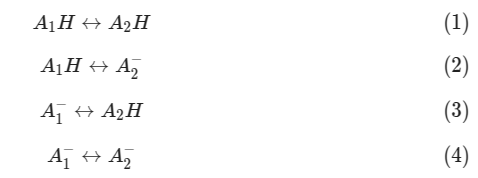
For example, 4 possible interactions for a pair of acids could be:
[](https://mccewiki.levich.net/uploads/images/gallery/2025-06/oBwimage.png)
If MCCE sampled acids *A1" id="bkmrk-a1" role="presentation" style="box-sizing: inherit; display: inline-block; line-height: 0; text-indent: 0px; text-align: left; text-transform: none; font-weight: normal; font-size: 20.944px; font-size-adjust: none; letter-spacing: normal; overflow-wrap: normal; word-spacing: normal; white-space: nowrap; float: none; direction: ltr; max-width: none; max-height: none; min-width: 0px; min-height: 0px; border: 0px; margin: 0px; padding: 1px 0px; position: relative;" tabindex="0">A1* and *A2" id="bkmrk-a2" role="presentation" style="box-sizing: inherit; display: inline-block; line-height: 0; text-indent: 0px; text-align: left; text-transform: none; font-weight: normal; font-size: 20.944px; font-size-adjust: none; letter-spacing: normal; overflow-wrap: normal; word-spacing: normal; white-space: nowrap; float: none; direction: ltr; max-width: none; max-height: none; min-width: 0px; min-height: 0px; border: 0px; margin: 0px; padding: 1px 0px; position: relative;" tabindex="0">A2* are both at 50% ionization, after MOnte Carlo sampling, from the ionization rate alone, we could not know the interaction is 50% of (2) and 50% of (3), 50% of (1) and 50% of (4), or a mix.
This is the limitation of mean fields energy analysis. Once we know the limitation, we can extract quite useful information of residue ionization.
#### MFE energy terms
Once step 4 is done, one can run mfe.py on a residue to break down the energy terms of a ionization free energy. The input residue has to be in file pK.out.
For example, in lysozyme pKa calculation, we obtained pKa output file pK.out.
```
```
$ cat pK.out
pH pKa/Em n(slope) 1000*chi2 vdw0 vdw1 tors ebkb dsol offset pHpK0 EhEm0 -TS residues total
NTR+A0001_ 5.095 0.985 0.015 -0.00 -0.01 -0.26 0.52 4.01 -0.95 -2.90 0.00 0.00 -0.11 0.29
LYS+A0001_ 9.593 0.998 0.027 -0.00 -0.00 0.00 0.15 0.46 0.29 -0.81 0.00 -0.00 -0.09 0.00
ARG+A0005_ 12.695 0.858 0.051 -0.01 -0.00 -0.00 -0.73 0.89 0.00 0.20 0.00 0.14 -0.35 0.14
GLU-A0007_ 3.192 0.944 0.010 -0.01 0.00 -0.19 -1.27 1.17 -0.22 1.56 0.00 0.30 -1.02 0.31
LYS+A0013_ 11.322 0.954 0.019 -0.00 -0.00 0.00 0.19 0.61 0.29 0.92 0.00 0.00 -2.01 0.00
ARG+A0014_ 13.330 0.934 0.004 -0.01 -0.00 0.00 0.07 -0.28 0.00 0.83 0.00 0.43 -0.60 0.44
HIS+A0015_ 6.816 0.988 0.065 -0.01 -0.01 0.00 1.44 1.33 -0.73 -0.16 0.00 0.36 -0.42 1.80
ASP-A0018_ 2.013 0.929 0.127 -0.01 -0.00 -0.16 -2.03 0.95 -0.62 2.74 0.00 0.40 -0.86 0.40
TYR-A0020_ 13.498 0.687 0.401 0.00 0.00 0.00 0.24 3.29 -0.37 -3.30 0.00 0.18 0.04 0.09
ARG+A0021_ 13.239 0.796 0.092 -0.01 -0.00 0.00 -0.09 0.11 0.00 0.74 0.00 0.28 -0.74 0.29
TYR-A0023_ 10.312 0.863 0.020 0.00 0.00 0.00 -1.17 1.98 -0.37 -0.11 0.00 0.29 -0.33 0.29
LYS+A0033_ 10.581 0.974 0.026 -0.00 -0.00 0.00 0.06 0.61 0.29 0.18 0.00 0.00 -1.09 0.05
GLU-A0035_ 5.133 0.880 1.144 -0.04 -0.01 -0.01 -1.26 2.16 -0.22 -0.38 0.00 0.26 -0.23 0.26
ARG+A0045_ 12.919 0.796 1.608 -0.03 -0.00 0.00 0.19 -0.32 0.00 0.42 0.00 0.45 -0.24 0.46
ASP-A0048_ 1.528 0.963 0.058 -0.01 0.00 -0.24 -2.52 3.22 -0.62 3.22 0.00 0.14 -3.01 0.17
ASP-A0052_ 3.330 0.859 0.170 -0.01 0.00 -0.10 -1.32 1.99 -0.62 1.42 0.00 0.46 -1.20 0.61
TYR-A0053_ >14.0 0.00 0.00 0.00 -1.70 4.45 -0.37 -3.80 0.00 0.00 8.03 6.61
ARG+A0061_ >14.0 -0.01 -0.00 0.00 0.69 0.15 0.00 1.50 0.00 0.42 -2.43 0.31
ASP-A0066_ 2.066 3.239 0.002 -0.01 0.02 -0.04 -5.30 7.34 -0.62 2.68 0.00 -0.11 -4.50 -0.55
ARG+A0068_ 13.604 0.768 0.028 0.12 1.81 0.16 0.29 -0.80 0.00 1.10 0.00 -0.19 -0.05 2.46
ARG+A0073_ 12.750 0.935 0.132 -0.01 -0.00 0.00 -0.12 0.10 0.00 0.25 0.00 0.35 -0.22 0.35
ASP-A0087_ 2.073 0.960 0.014 -0.02 0.01 -0.21 -1.88 1.24 -0.62 2.68 0.00 0.31 -1.18 0.31
LYS+A0096_ 10.631 0.831 0.307 -0.00 0.00 0.00 -1.52 1.26 0.29 0.23 0.00 0.00 -0.25 0.01
LYS+A0097_ 10.813 0.918 0.072 -0.00 -0.00 0.00 -0.27 0.07 0.29 0.41 0.00 0.00 -0.51 -0.00
ASP-A0101_ 3.988 1.009 0.010 -0.00 -0.05 -0.10 0.04 1.15 -0.62 0.76 0.00 0.57 -1.17 0.58
ARG+A0112_ 12.956 0.923 0.080 -0.01 -0.00 0.00 -0.27 0.77 0.00 0.46 0.00 0.55 -0.90 0.59
ARG+A0114_ 13.257 0.968 0.050 -0.01 -0.00 0.00 -0.09 -0.29 0.00 0.76 0.00 0.34 -0.35 0.35
LYS+A0116_ 9.554 0.941 0.042 -0.00 -0.00 0.00 0.12 0.43 0.29 -0.85 0.00 0.00 0.02 0.01
ASP-A0119_ 3.596 1.005 0.031 -0.01 0.00 -0.24 -1.08 1.95 -0.62 1.15 0.00 0.09 -1.15 0.09
ARG+A0125_ 13.083 0.915 0.005 -0.01 -0.00 -0.00 0.36 -0.18 0.00 0.58 0.00 0.45 -0.75 0.45
ARG+A0128_ 13.586 0.939 0.008 0.00 -0.00 0.00 0.08 -0.81 0.00 1.09 0.00 0.45 -0.36 0.45
CTR-A0129_ 2.464 0.905 0.072 -0.01 -0.01 -0.12 -0.06 1.66 0.00 1.29 0.00 0.49 -2.75 0.49
```
```
Now we would like to know why ASP52 has a low pKa of 3.33
```
```
$ mfe.py ASP-A0052_ -c 0.1
Residue ASP-A0052_ pKa/Em=3.33
=================================
Terms pH meV Kcal
---------------------------------
vdw0 -0.01 -0.85 -0.02
vdw1 0.00 0.21 0.00
tors -0.10 -5.89 -0.14
ebkb -1.32 -76.87 -1.81
dsol 1.99 115.58 2.72
offset -0.62 -36.17 -0.85
pH&pK0 1.42 82.42 1.94
Eh&Em0 0.00 0.00 0.00
-TS 0.00 0.00 0.00
residues -1.20 -69.73 -1.64
*********************************
TOTAL 0.15 8.70 0.20 sum_crg
*********************************
ASNA0044_ -0.44 -25.31 -0.59 0.00
ARGA0045_ -0.12 -6.74 -0.16 1.00
ASNA0046_ -0.16 -9.25 -0.22 0.00
ASPA0048_ 0.51 29.65 0.70 -0.96
SERA0050_ 0.12 7.04 0.17 0.00
GLNA0057_ 0.22 12.63 0.30 0.00
ASNA0059_ -0.99 -57.31 -1.35 0.00
ARGA0061_ -0.27 -15.65 -0.37 1.00
ASPA0066_ 0.39 22.84 0.54 -1.00
ARGA0112_ -0.19 -11.15 -0.26 1.00
ARGA0114_ -0.10 -5.86 -0.14 1.00
=================================
```
```
Program computes the ionization free energy, specifically, the free energy difference between the ionized ASP and the neutral ASP.
If we don't specify pH, mfe.py uses the midpoint pH or Eh.
Energy terms:
- **vdw0:** Van der Waals interaction within the residue. Since the vdw interaction is similar to ionized and neutral ASP, the contribution to *ΔG" id="bkmrk-%CE%94g" role="presentation" style="box-sizing: inherit; display: inline-block; line-height: 0; text-indent: 0px; text-align: left; text-transform: none; font-weight: normal; font-size: 20.944px; font-size-adjust: none; letter-spacing: normal; overflow-wrap: normal; word-spacing: normal; white-space: nowrap; float: none; direction: ltr; max-width: none; max-height: none; min-width: 0px; min-height: 0px; border: 0px; margin: 0px; padding: 1px 0px; position: relative;" tabindex="0">ΔG* of ionization is small.
- **vdw1:** Van der Waals interaction to the protein backbone. Again the contribution to pKa is usually small.
- **tors:** Side chain torsion energy. The contribution to pKa is usually small.
- **ebkb:** The protein backbone electrostatic interaction. The protein secondary structure especially helices have a dipole that may affect the ionized residue more than neutral form of the residue, therefore it could be a factor of pKa.
- **dsolv:** The desolvation energy. The ionized residue is less stabilized im protein than in solution. This makes the ionization inside protein harder and it links to a positive free energy to the reaction from neutral residue to ionized residue.
- **offset:** The is a system correction of pKa calibrated by benchmark. It captures the terms not counted by MCCE.
- **pH&pK0:** Solution pH effect to the ionization. It is environment pressure to the residue ionization. To an acid, low solution pH makes the ionization (releasing proton) easy so it contributes as a favorable energy. To a base, low pH makes ionization harder. When pH equals residue's solution pKa, the environment pH is at the balance point, where the contribution is 0.
- **Eh&Em0:** Environment Eh effect to redox reaction. This works similarily as pH&pK0.
- **-TS:** Entropy term. The number of rotamers of neutral and ionized residues generated by MCCE may be different. The effect of number of rotamers on two ionization states act like entropy. Since this may not be a desired effect, one can enable entropy correction in step 4, Monte Carlo sampling. If entropy correction is enabled in MC, the entropy effect has been eliminated and entropy should be set to 0 in MFE analysis. Program mfe.py is able to know how MC is done and handle this accordingly, or one can turn on or off in MFE manually.
- **residues:** Total pairwise interaction from other residues. Other residues may shift the ionization free energy depending on their dipole orentation and charge.
- **TOTAL:** Total free enegy of ionization reaction. It the sum of all above terms.
- **Redisue breakdown:** Individual residue contribution. This part is the breakdown of term **residues**.
At the midpoint, [AH]=[A−]" id="bkmrk-%5Bah%5D%3D%5Ba%E2%88%92%5D" role="presentation" style="box-sizing: inherit; display: inline-block; line-height: 0; text-indent: 0px; text-align: left; text-transform: none; font-style: normal; font-weight: normal; font-size: 20.944px; font-size-adjust: none; letter-spacing: normal; overflow-wrap: normal; word-spacing: normal; white-space: nowrap; float: none; direction: ltr; max-width: none; max-height: none; min-width: 0px; min-height: 0px; border: 0px; margin: 0px; padding: 1px 0px; position: relative;" tabindex="0">\[*AH*\]=\[*A−*\]. This means conformers of *AH" id="bkmrk-ah-3" role="presentation" style="box-sizing: inherit; display: inline-block; line-height: 0; text-indent: 0px; text-align: left; text-transform: none; font-weight: normal; font-size: 20.944px; font-size-adjust: none; letter-spacing: normal; overflow-wrap: normal; word-spacing: normal; white-space: nowrap; float: none; direction: ltr; max-width: none; max-height: none; min-width: 0px; min-height: 0px; border: 0px; margin: 0px; padding: 1px 0px; position: relative;" tabindex="0">AH* and conformers of *A−" id="bkmrk-a%E2%88%92-5" role="presentation" style="box-sizing: inherit; display: inline-block; line-height: 0; text-indent: 0px; text-align: left; text-transform: none; font-weight: normal; font-size: 20.944px; font-size-adjust: none; letter-spacing: normal; overflow-wrap: normal; word-spacing: normal; white-space: nowrap; float: none; direction: ltr; max-width: none; max-height: none; min-width: 0px; min-height: 0px; border: 0px; margin: 0px; padding: 1px 0px; position: relative;" tabindex="0">A−* strike a balance, and the transition energy *ΔG" id="bkmrk-%CE%94g-1" role="presentation" style="box-sizing: inherit; display: inline-block; line-height: 0; text-indent: 0px; text-align: left; text-transform: none; font-weight: normal; font-size: 20.944px; font-size-adjust: none; letter-spacing: normal; overflow-wrap: normal; word-spacing: normal; white-space: nowrap; float: none; direction: ltr; max-width: none; max-height: none; min-width: 0px; min-height: 0px; border: 0px; margin: 0px; padding: 1px 0px; position: relative;" tabindex="0">ΔG* between them is 0 under this condition. The value *ΔG" id="bkmrk-%CE%94g-4" role="presentation" style="box-sizing: inherit; display: inline-block; line-height: 0; text-indent: 0px; text-align: left; text-transform: none; font-weight: normal; font-size: 20.944px; font-size-adjust: none; letter-spacing: normal; overflow-wrap: normal; word-spacing: normal; white-space: nowrap; float: none; direction: ltr; max-width: none; max-height: none; min-width: 0px; min-height: 0px; border: 0px; margin: 0px; padding: 1px 0px; position: relative;" tabindex="0">ΔG* in pH unit also means how far away the pKa is from the solution pH. At the midpoint, ΔG=0" id="bkmrk-%CE%94g%3D0" role="presentation" style="box-sizing: inherit; display: inline-block; line-height: 0; text-indent: 0px; text-align: left; text-transform: none; font-style: normal; font-weight: normal; font-size: 20.944px; font-size-adjust: none; letter-spacing: normal; overflow-wrap: normal; word-spacing: normal; white-space: nowrap; float: none; direction: ltr; max-width: none; max-height: none; min-width: 0px; min-height: 0px; border: 0px; margin: 0px; padding: 1px 0px; position: relative;" tabindex="0">*ΔG*=0 and residue pKa is the same as envrionment pH.
In the above example, ASP52 has low pH because a pretty big stabilization from ASN59.
We can also do mfe anaylysis off the midpoint, for example at physiological pH about 7. The command option "-p 7" sets the mfe point.
```
$ mfe.py ASP-A0052_ -c 0.1 -p 7
Residue ASP-A0052_ pKa/Em=3.33
=================================
Terms pH meV Kcal
---------------------------------
vdw0 -0.02 -0.97 -0.02
vdw1 -0.01 -0.52 -0.01
tors -0.11 -6.30 -0.15
ebkb -1.32 -76.59 -1.80
dsol 1.97 114.53 2.69
offset -0.62 -36.17 -0.85
pH&pK0 -2.25 -130.60 -3.07
Eh&Em0 0.00 0.00 0.00
-TS 0.00 0.00 0.00
residues -1.81 -105.25 -2.47
*********************************
TOTAL -4.17 -241.87 -5.68 sum_crg
*********************************
GLUA0035_ 0.85 49.08 1.15 -0.98
ASNA0044_ -1.00 -57.84 -1.36 0.00
ARGA0045_ -0.11 -6.28 -0.15 1.00
ASNA0046_ -0.85 -49.43 -1.16 0.00
ASPA0048_ 0.52 30.08 0.71 -1.00
SERA0050_ 0.13 7.43 0.17 0.00
GLNA0057_ 0.18 10.47 0.25 0.00
ASNA0059_ -1.20 -69.75 -1.64 0.00
ARGA0061_ -0.28 -16.15 -0.38 1.00
ASPA0066_ 0.40 22.96 0.54 -1.00
ARGA0112_ -0.20 -11.56 -0.27 1.00
=================================
```
We see ASP52 is surrounded by these polar residues.gets extra stabilization from ASN44 and ASN46 besides ASN59. The stabilization is bigger at pH 7. Actually the back calculated pKa 7−4.17=2.83" id="bkmrk-7%E2%88%924.17%3D2.83" role="presentation" style="box-sizing: inherit; display: inline-block; line-height: 0; text-indent: 0px; text-align: left; text-transform: none; font-style: normal; font-weight: normal; font-size: 20.944px; font-size-adjust: none; letter-spacing: normal; overflow-wrap: normal; word-spacing: normal; white-space: nowrap; float: none; direction: ltr; max-width: none; max-height: none; min-width: 0px; min-height: 0px; border: 0px; margin: 0px; padding: 1px 0px; position: relative;" tabindex="0">7−4.17=2.83 is lower than titrated value 3.33" id="bkmrk-3.33" role="presentation" style="box-sizing: inherit; display: inline-block; line-height: 0; text-indent: 0px; text-align: left; text-transform: none; font-style: normal; font-weight: normal; font-size: 20.944px; font-size-adjust: none; letter-spacing: normal; overflow-wrap: normal; word-spacing: normal; white-space: nowrap; float: none; direction: ltr; max-width: none; max-height: none; min-width: 0px; min-height: 0px; border: 0px; margin: 0px; padding: 1px 0px; position: relative;" tabindex="0">3.33, indicating extra stabilization at pH 7.
With MFE analysis, one can quickly determine what residues affect the pKa most therefore identify the influential sites.